
If you walk into any gift shop in Inverness or Drumnadrochit, you’re going to be hit by a wall of green, long-necked plush toys. Don’t misunderstand, we love Nessie. The Loch Ness Monster is a brilliant bit of marketing and a genuine mystery that has kept people staring at the water for decades. But honestly? If you only focus on the monster in the loch, you’re missing about 95% of the actual magic and the terror of the Scottish Highlands.
The folklore of this place is a lot darker, weirder, and more deeply connected to the landscape than a shy plesiosaur. It’s a tapestry of stories woven from Gaelic culture, the brutal weather, and the sheer isolation of the glens. These aren’t just “bedtime stories.” For the people who lived here centuries ago, these legends were a way to explain why the river suddenly rose and drowned a horse, or why a child went missing in the woods.
So, let’s leave the binoculars and the sonar equipment behind. We’re going into the stories that actually keep the locals looking over their shoulders when the mist starts to roll in.
Jump to Section
Top Myths and Legends of the Scottish Highlands
The Water Horses: Kelpies vs. Each-Uisge
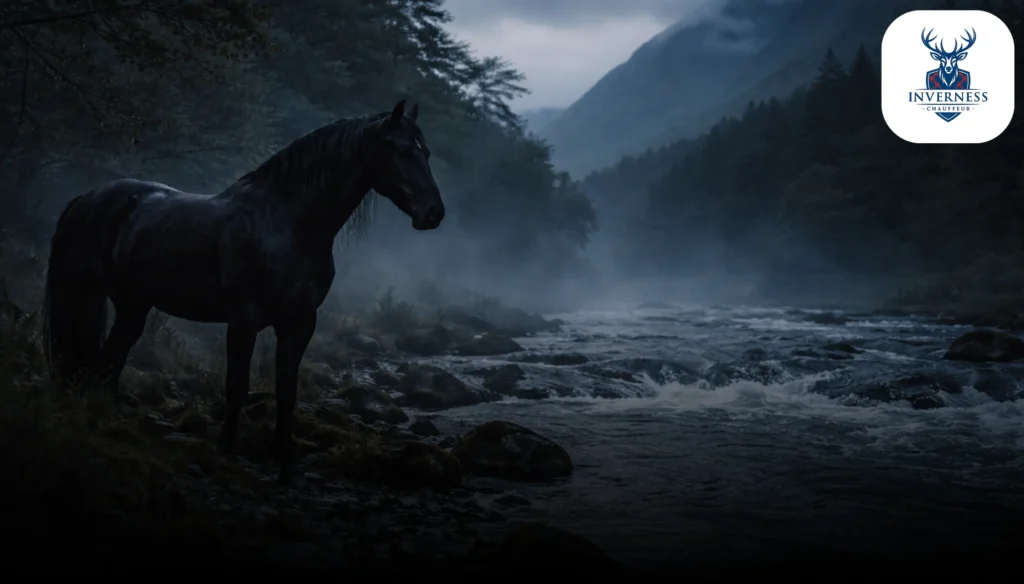
Most people have heard of Kelpies, largely thanks to the massive, stunning sculptures near Falkirk. But in the actual Highland tradition, a Kelpie is a bit more than just a “water horse.” They are shape-shifters, usually appearing as a beautiful black horse standing by a river, looking perfectly tame and waiting for a rider.
Here’s where the story gets grim. If you mount a Kelpie, its skin becomes adhesive. You can’t get off. It then lunges into the deepest part of the river, dragging you down to drown and eat you. It’s a cautionary tale, basically a medieval way of telling kids, “Don’t go near the fast-moving water.”
But there’s something even worse than a Kelpie: the Each-Uisge (pronounced eck-oosh-kya). While the Kelpie haunts rivers, the Each-Uisge lives in the sea lochs and deep freshwater lochs. This thing is the most dangerous creature mostly in the form of a beautiful man or a horse in Scottish mythology. It doesn’t just drown you; it is said to tear its victims apart, leaving only the liver to float to the surface.I’ve stood by the banks of Loch Maree at twilight, and let me tell you, when the water is that dark and still, you stop thinking about “mythology” and start thinking about how quickly you can get back to your car.
There is a site in the Highlands called Lochan nan Corp as in the Loch of the Dead. It got its name after a group of people supposedly tried to ride a “horse” they found near the water. The horse expanded its back to fit all of them, then plunged into the ice. These stories aren’t just myths; they are the scars left by a landscape that has always been more powerful than the people living in it.
The Selkies: The Melancholy of the Seal-Folk
If the water horses represent the danger of the Highlands, the Selkies represent its heartbreak. This is probably the most beautiful part of our folklore. If you go out to the Outer Hebrides or Harris, Lewis, or the Uists you’ll see seals everywhere. They follow the fishing boats, their heads bobbing in the surf. They have these incredibly soulful, almost weeping eyes. It’s no wonder the coastal communities believed they were “Selkies”. “Selkies are “seal-folk” that live as seals in the ocean but can shed their skins to become humans on land.
The stories usually follow a specific, tragic pattern: a lonely fisherman steals a Selkie woman’s skin while she’s dancing on the beach, preventing her from returning to the sea. He hides the skin, they marry, and they have children. But the Selkie is always looking at the horizon. Eventually, her child finds her hidden skin and she immediately returns to the ocean, leaving her human family behind.
It’s a story about the “pull” of the sea. For centuries, the people of the Highlands and Islands lived by the ocean. It gave them fish, it gave them trade, but it also took their sons and husbands in storms. The Selkie is the embodiment of that relationship, something beautiful that can never truly be “owned” or tamed. It reflects a culture that understands that some things and some people simply belong to the wild.
The Bean-Nighe: The Washer at the Ford
Now, if you want something that will actually give you nightmares, we need to talk about the Bean-Nighe (the ben-neeya). In Irish lore, she’s the Banshee, but the Scottish version is much more physical and, frankly, more unsettling.
She is the “Washer at the Ford.” She’s usually described as a small woman dressed in green, with webbed feet, one nostril, and one protruding tooth. You find her at a remote stream, washing the blood-stained grave clothes of someone who is about to die. If you see her washing your own shirt, well… it’s been a good run.
What’s fascinating is that the Bean-Nighe was said to be the spirit of a woman who died in childbirth. She was cursed to wash clothes until the day her “natural” life would have ended. There’s a type of weird ritual to interact with her. If you’re brave enough to sneak up and suck her breast, she’s obligated to grant you three wishes and tell you who is about to die. Personally, I’d just keep walking.
The Cailleach: The Queen of Winter
You can’t understand the Scottish landscape without the Cailleach. She isn’t just a ghost or a monster; she is a goddess. She is the “Mother of Mountains,” and she’s responsible for the very shape of the Highlands. According to legend, the Cailleach created the Highlands by accident. She was walking across the land with a giant apron full of rocks, and wherever she dropped a stone, a mountain grew. When she got tired, she sat down and created the lochs.
But her true power is in the seasons. On the night of Samhain (what we now call Halloween), the Cailleach takes her staff and strikes the ground, turning the grass to frost. She rules the “dark half” of the year. In the spring, she fights a battle against the spirit of Summer, and eventually, she turns into a large grey stone until the winter returns.
If you want to see how much this still matters, you have to go to Glen Lyon. Deep in the glen is a small hut called Tigh nam Bodach. Inside are several water-worn stones representing Cailleach, her husband (the Bodach), and her children. For hundreds of years, local people have performed a ritual where they bring the stones out of the hut in the spring and put them back inside in the winter. It is one of the oldest surviving pagan rituals in Europe. It’s a reminder that in the Highlands, the seasons aren’t just weather, they are a struggle between living forces.
The Sithe: Why You Don’t Call Them “Fairies”
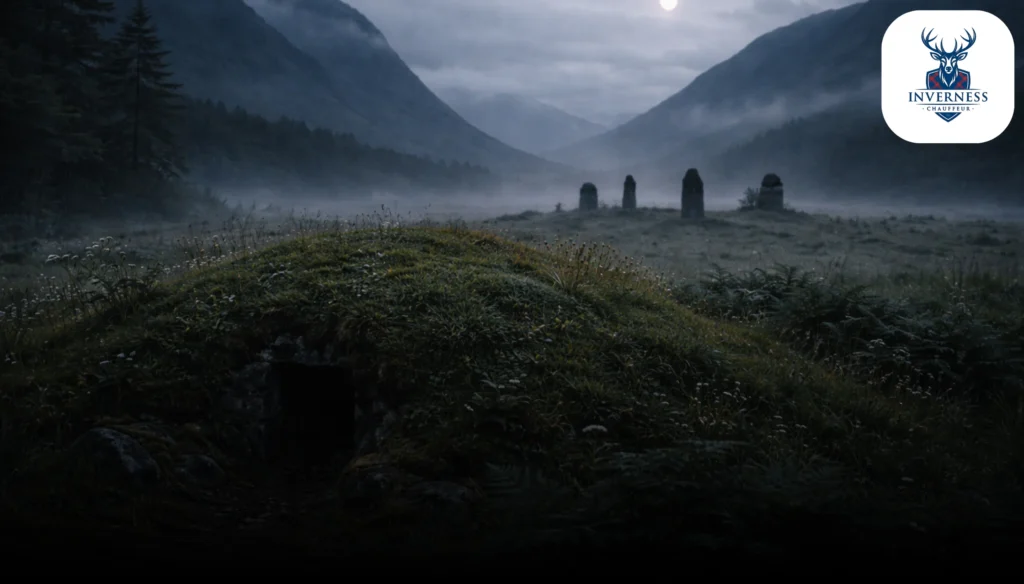
In the Highlands, there are Sithe (pronounced shee) not fairies named “Tinkerbell”, and you generally want to avoid them. These aren’t cute little winged creatures, they are the “Aos Sí” a powerful, hidden race that lives in the Sithean (fairy mounds).
The Sithe are why people in the Highlands are traditionally very polite to strangers. You never know who you are talking to. These beings are known for “the kidnapping.” There are hundreds of stories of pipers or fiddlers being lured into a green hill to play for a party. They think they’ve been gone for an hour, but when they step back outside, a hundred years have passed. Their homes are gone, their families are dead, and they are left as relics of a forgotten time.
If you go to the Fairy Pools on Isle of Skye or the Fairy Glen near Uig, you’ll see people leaving coins or stacking stones. The locals generally advise against the stone stacking as it messes with the landscape but the sense of “otherness” in those places is real. The Sithe represents the unpredictability of the land. If you disrespect a fairy mound like building a road through it, bad luck will follow you for years. It sounds like superstition until you talk to a Highland road contractor who has had three excavators break down in the same spot.
The Blue Men of the Minch
This is a very specific legend found in the Minch, the strait between the mainland Highlands and the Outer Hebrides. The Blue Men are exactly what they sound like: blue-skinned creatures that live in the water and look for ships to sink.
One thing incredibly surprising about them is that they are obsessed with poetry. According to the stories, when a ship enters their territory, the Chief of the Blue Men will rise from the waves and deliver two lines of poetry. The captain of the ship must respond with two lines that complete the rhyme. If the captain succeeds, the Blue Men let the ship pass. If he fails, they drag the ship to the bottom.
I love this because it highlights the importance of oral tradition and wit in Gaelic culture. Even the monsters expect you to be good with words. It also explains the “Shiant Isles” (the Enchanted Isles), where the water is notoriously treacherous.
The Glaistig and the Brownies: Household Spirits
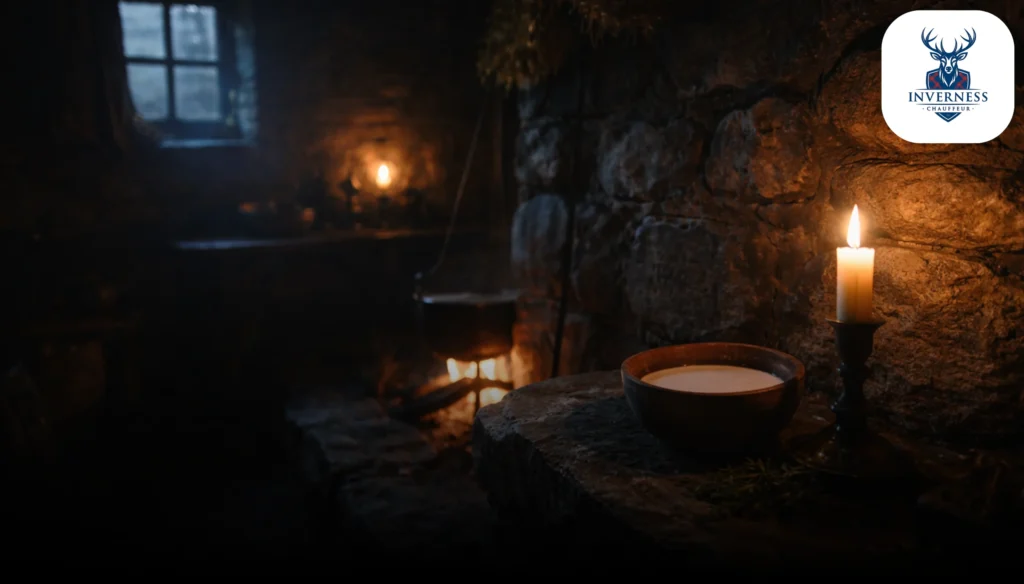
Not all Highland legends are out there to kill you. Some just want a bowl of milk. The Glaistig is a half-woman, half-goat spirit. She’s often associated with a specific castle or farm. If the family treated her well, specifically by leaving a bowl of milk on a “hollowed stone” every night she would protect the cattle and help with the chores. If you offend her, she’ll lead your sheep off a cliff.
Then you have Brownies, who are similar but more shy and hidden. They do the housework while you sleep. But here’s the rule: you can never thank them, and you can never give them clothes. If you give a Brownie a new suit, he’ll think he’s too fancy for chores and leave forever.
These stories speak to the domestic reality of Highland life. When you’re living in a tiny black house in the middle of a moor, the idea that something is watching over your home is comforting. It’s about the “spirit of the place.”
The Brahan Seer: The Highland Nostradamus
Let’s move from spirits to a real person who became a legend: Coinneach Odhar, better known as the Brahan Seer. In the 17th century, he was the “prophet” of the Highlands. He supposedly used a small “raven stone” with a hole in it to see the future.
His prophecies are eerily accurate. He predicted the Caledonian Canal (saying ships would sail behind Tomnahurich hill), the Highland Clearances, and even the coming of the railway (referring to “long black carriages without horses”).
His end was as dramatic as his life. His most famous prophecy was that he insulted Lady Seaforth, the wife of his employer, by telling her that her husband was currently in Paris visiting other women. Enraged, she ordered him to be burned in a spiked tar barrel. As the flames rose, the Seer made a final, incredibly specific prophecy about the downfall of the Seaforth family line. He predicted that their last heir would be deaf and mute and that all his sons would die before him.
A hundred years later, every single detail came true. Today, at Chanonry Point (near Fortrose), there is a stone memorial marking the spot of his execution. It’s a place of immense beauty, usually filled with people watching dolphins, but the shadow of the Seer still hangs over it.
The Sianach: The Great Monster Wolf
In the deep, dark forests and high plateaus of the Cairngorms, they tell stories of the Sianach. This isn’t just a wolf; it’s a massive, demonic beast sometimes described as a wolf, sometimes as a giant deer that stalks lone travelers.
Unlike the Each-Uisge, which stays in the water, the Sianach is a creature of the land and the storm. It’s said to move with the wind, meaning you can’t hear it coming until it’s right on top of you. This legend probably stems from the fact that gray wolves used to roam Scotland (the last one was supposedly killed in 1743). The fear of the “big predator” in the woods is baked into our DNA, and the Sianach is the supernatural amplification of that fear.
Why These Stories Still Matter
You might be wondering: Does anyone actually believe this stuff anymore?
The answer is complicated. No one is sitting at home in Inverness genuinely worried that a Blue Man is going to rhyme them to death. But the culture of the Highlands is still deeply rooted in these stories. They are part of the Gaelic language, the place names, and the way we view the environment.
When you see a mountain like Ben Macdui, and you hear about the Am Fear Liath Mòr (The Big Grey Man of Ben Macdui) that follows hikers and fills them with a sudden, uncontrollable “panic” (a real phenomenon called the fear), you realize these stories are just a way to describe a very real, very human reaction to a vast, indifferent landscape.
The Highlands are huge. They are beautiful, but they are also dangerous. Folklore is the bridge we build to try and make sense of that beauty and danger. It’s about respecting the land.
How to Experience Highland Folklore Responsibly
If you’re coming to Scotland to find these stories, you have to look beyond the “Monster Museums.”
- Visit the Standing Stones: Go to Clava Cairns or Callanish. These aren’t just “Outlander” props. They are ancient, astronomical sites that have been centers of folklore for thousands of years. Stand there in the wind and tell me you don’t feel something.
- Listen to the Music: Go to a ceilidh or a “session” in a local pub (like The Gellions in Inverness). Highland music is narrative. The songs are about the Selkies, the battles, and the spirits. The stories are kept alive in the fiddle tunes and the Gaelic “waulking songs.”
- Read the Landscape: Look at a map. If a place is called Coire nan Gruagach (Corrie of the Maidens) or Sithean Bhealaich, there’s a story there. The Gaelic names are a literal map of the mythology.
- Talk to the Locals (Slowly): If you find yourself in a quiet pub in Wester Ross or Sutherland, ask about the local stories. Don’t be “that tourist” who demands a ghost story. Just listen. Often, the best legends are the ones people still mention casually, like they’re talking about the neighbor’s annoying dog.
Final Thoughts
The Scottish Highlands are one of the few places left in the world where the veil between the “real world” and the “old world” feels thin. You can spend your whole trip looking for a monster in a loch, and you might have a great time. But if you open your eyes to the Kelpie in the river, the Cailleach in the storm, and the Sithe in the green hill, the landscape becomes something much richer.
It becomes a living story. It becomes a place where every rock has a name and every glen has a memory. Just be cautious if you see a beautiful horse standing by a river, don’t try to ride it. And if you hear someone washing clothes in a stream miles from the nearest house… maybe just head back to the hotel.

An experienced chauffeur who enjoys exploring the beautiful landscapes of Inverness and writing about her experiences. Passion for driving and storytelling, desire to excel in her career and personal interests.
1 Comment
[…] history and the odd local aside that no audio guide bothers with, there’s a whole world of Scottish Highlands folklore that comes alive when someone who grew up with it is telling […]