
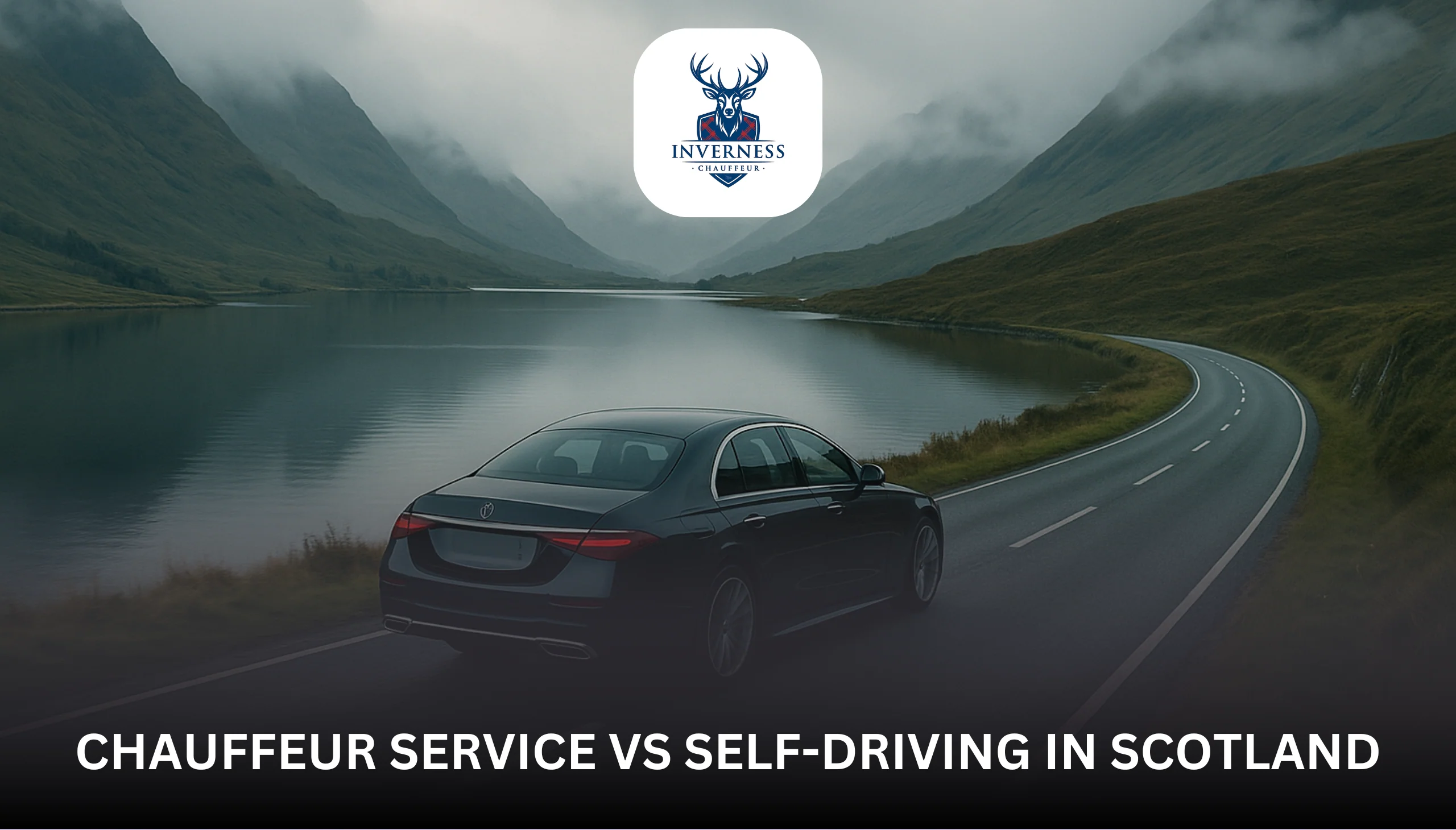
Scotland’s landscape is famously diverse, ranging from the vibrant, bustling streets of Edinburgh and Glasgow to the vast remote solitude of the Northwest Highlands. Day trips to well-signposted historic castles, presents a different driving challenge than a comprehensive tour of the Isle of Skye, the winding roads of Argyll or the complete North Coast 500 route. Furthermore, your personal travel philosophy also matters. Are you seeking a restorative holiday where every day detail is managed, or an adventurous expedition where the thrill of navigation is part of the fun? Acknowledging these preferences from the outset help you make your choice.
When planning a trip to Scotland Highland, one of the most important decision you’ll make is how to travel across the country. The choice between hiring a professional chauffeur service and renting a car to drive yourself influences your daily experience, budget and overall enjoyment.A lot of travellers first think about driving themselves, it seems cheaper and gives you freedom. Many people see chauffeur services as an unaffordable luxury. The truth is, both options have distinct advantages and challenges, and the right choice really depends on your travel style, group size, and priorities. This guide provides a balanced, detailed comparison to help you decide which transportation method better suits your Scottish adventure.
Jump to Section
How to Navigate Scottish Roads
The reality of driving in Scotland differs considerably from the romantic image of effortless cruising through open landscapes. If you choose to self drive, you must prepare for specific challenges that require constant attention and adaptation.
For visitors coming from countries that drive on the right hand side, the immediate difficulty is adjusting to left hand traffic. This affects everything from navigating roundabouts which are numerous, judging turns correctly and instinctively looking the right way when pulling into traffic.Honestly, the first day or so can be really stressful, and you need to be concentrating constantly.
The Challenge of Road Design and Geography
Beyond the sight of the road, the very design of the roads can be perplexing. For example, the Scottish “Slip Roads” for merging onto a dual carriageway-highway. is often very short, requiring quick acceleration and confidence.Complex urban junctions like the ones in Edinburgh’s Old Town or near Glasgow Airport rely heavily on filter lanes. You have to assess the lanes really fast. Also, traffic lights aren’t usually hanging overhead. They’re often positioned on the near side curb. It’s a small difference, but it catches your eye. All these constant adjustments lead to mental tiredness and that really takes away from your enjoyment of the scenery for the first few days.
Beyond city limits, the road conditions themselves present the next set of challenges. Many of Scotland’s most scenic roads, including significant sections of popular tourist trails like the North Coast 500 and roads on the Isle of Skye, are single track roads. These narrow roads require you to constantly watch for oncoming traffic and use designated passing places to pull over and let others by.There’s a whole etiquette to it, requiring quick decisions that might be totally unfamiliar to foreign drivers. Furthermore, rural roads are shared with livestock such as sheep and Highland cattle. They wander freely and can appear out of nowhere, so you have to drive slowly and cautiously everywhere.
The Advantage of a Local Driver
It’s also vital to understand the geography. Distances on a map can be deceptive. A 50 mile journey on A-roads and single truck lanes in the Highlands can easily take two hours or more, not the one hour a traveler might expect. Routes like the A82 along Loch Lomond and through Glencoe, while stunning, are busy winding and require overtaking slow vehicles like caravans and trucks with great care. The famous Bealach na Bà to Applecross is an extreme example. it’s a steep single track mountain pass with hairpin bends that is not suitable for large vehicles, nervous drivers or in poor weather a self driver must research each major route in their itinerary to avoid Unexpectedly challenging situations.
In contrast, hiring a chauffeur service removes these navigational pressures entirely. A professional driver possesses mastered skills for these exact conditions. They handle the single track roads with practiced ease. They can anticipate potential meeting points with other vehicles and navigate city centers and complex junctions without hesitation. This allows you, the passenger, to shift your focus from the road to the scenery. Your mental energy is freed for observation and enjoyment rather than being consumed by the mechanics of driving.
Their knowledge extends to pure logistics. They know, for example, that the parking lot for the Glenfinnan Viaduct (the Harry Potter bridge) is absolutely full by mid-morning. They’ll plan your schedule to visit later in the day when the crowds thin out. They know the best order to visit sites on the Isle of Skye is Trottenish Loop to avoid the convoy of tour buses. This strategic navigation saves hours of fitting and frustration, time that is directly returned to your holiday for actual exploration. Your driver is way more than just a chauffeur; they’re your logistical manager. They optimize your route for maximum efficiency and zero hassle.
What Safety and Weather Condition to Consider

Scotland’s climate is famously variable, capable of shifting rapidly from sunshine to rain, fog or strong winds. These changing conditions directly impact road safety and driving difficulty.
When you are self driving you bear full responsibility for assessing road safety in all weather. A mountain pass that was clear in the morning might become misty, rainy or icy by afternoon. You must decide whether to proceed, seek an alternative route, or delay your journey. You need to research and be confidence. Additionally, in the unlikely event of a mechanical issue like a flat tire in a remote area with poor mobile phone signal, you are the one who must resolve the problem.
Understanding Weather-Specific Hazards
Weather poses unique hazards. Side winds on exposed bridges like the Skye Bridge or coastal roads like those in Sutherland can be severe enough to sway a vehicle. Sudden fog can descend in Glens or Lochs, reducing visibility to a few meters in minutes. In autumn and winter, black ice is a genuine threat on shaded stretches of a road, even if the air temperature seems mild. Rainfall makes narrow roads slick and increases stopping distances. As a self driver, you must be prepared to slow down significantly, use fog lights appropriately and know when to postpone travel. Checking dedicated resources like Traffic Scotland’s website for live updates on road conditions and closures becomes a necessary daily task.
A professional chauffeur, on the other hand, provides a layer of safety and assurance. These drivers are trained in advanced driving techniques and have extensive experience handling diverse weather conditions. Specific to Highlands and Islands, they know which roads are the most exposed to high winds, which Glens are prone to sudden fog and which passes may close first in wintry weather. They can make informed decisions to ensure your safety and comfort. Furthermore, all vehicle related concerns, maintenance, security and handling any issues are managed by the services. Your chauffeur ensures the vehicle is secured at stops and that your luggage is safe, offering significant peace of mind.
The Value of a Safety Net for Families
Peace of mind is especially valuable for families. Parents don’t need to worry about their own driving fatigue or stress levels affecting the family’s mood. Children’s safety is in the hands of a professional whose sole job is to operate the vehicle safely. The chauffeur’s vehicle is also typically equipped with full breakdown coverage, and they have direct links to assistance services. Ensuring that even a remote mechanical problem would be resolved swiftly, often with a backup vehicle sent out if needed. This comprehensive safety net allows every member of the travelling party to fully relax.
How to Manage Time and Fatigue
How you use your time in transit greatly affects the quality of your trip. Driving in Scotland is often more time consuming and tiring than it appears on a map.
As a self driver you must account for active driving time. The winding, slow paced nature of many Scottish roads mean a 100 mile journey can take over 3 hours of concentrated effort after several hours of negotiating single track roads, roundabouts and unfamiliar signage, it’s common for the driver to arrive at a destination feeling fatigued. This fatigue can detract from the energy you have available for exploring once you arrive.
The Hidden Time Cost of Trip Administration
The time cost extends beyond travel. As a self driver you also spend time on trip administration, filling out rental paperwork, inspecting the vehicle for pre-existing damage, figuring out the fuel type and cap, programming the GPS, finding and paying for parking at every stop and refueling before returning the car. What seems like a six hour travel day can easily consume 7 to 8 hours of your attention when you factor in these tasks. This administrative burden, while manageable, is time not spent sightseeing, dining, or relaxing.
Opting for a chauffeur service converts travel time into usable personal time. The time spent between destinations is no longer dedicated to a demanding task. Instead, you can relax, read, plan the details of your next stop, or simply enjoy uninterrupted views and conversation with your family. For families, this means parents can both engage with children or the landscape, rather than one person being focused on the road. For business travelers, this transit time can become productive work time. This efficient use of time often translates to a more relaxed and immersive holiday, as you arrive at each location feeling refreshed.
Gaining Flexibility and Door-to-Door Ease
This model allows for flexible pacing, if you are particularly enchanted by a view over Loch Ness, you can ask your driver to pause at a safe spot without worrying about holding up traffic behind you on a single track road. Conversely, if a site is crowded or less interesting than anticipated, you can move on immediately. The chauffeur handles the parking and meeting point, so you can be picked up right at the entrance of an attraction rather than walking from a distant car park. This door to door service, especially in rain, is a subtle but huge luxury Chauffeur Service that streamlines your day and conserves physical energy for where it matters most.
How Much Both Cost – Comprehensive Cost Analysis

Cost is a primary factor for more travelers and a true comparison requires looking beyond the initial daily rate to the total cost and value of your trip.
The self drive option has several additional expenses beyond the basic car rental fee. You must budget for comprehensive insurance. Highly recommended for Peace of Mind on unfamiliar roads. The total cost of fuel, which is higher in the UK than in many other countries, and parking. Hotel city centers and popular attractions, which can be substantial if your itinerary includes ferry crossings to islands. The cost for a rental car is significantly higher than a pedestrian ticket. These combined costs can add 50% or more to the base rental price.
Detailed Cost Breakdown: A Self-Drive Example
To illustrate, consider a one week rental of a standard estate car station wagon for a family of four. The base rental might be £350. Adding premium insurance with a low or zero excess could add £150. Fuel for 800 miles of mixed driving may cost £180. Parking in Edinburgh, Glasgow, and at various castles could easily total £50- £70. A return ferry crossing for the car to the Isle of Mull might cost £90. The total cost rises from £350 to approximately £820- £840. This is before accounting for any potential tolls. Congestion charges like Glasgow’s low Emission zone compliance fee for older cars, are the cost of unexpected minor damage, like a chipped windshield from gravel roads.
A chauffeur service provides a more transparent and inclusive cost structure. While the daily rate is higher, it typically encompasses the vehicle, the professional driver, all fuel insurance, road taxes and parking fees for groups of four or more. The per person cost can become comparable to renting a premium vehicle and accounting for all extras when you consider the value of the driver’s time expertise and the conversion of travel time into leisure time, the financial picture shifts. It transforms from a simple transport cost into a value added experience, often making it a financially sensible choice for families or small groups seeking a seamless, high quality trip.
Evaluating Chauffeur Value: A Comparative Example
For a comparable one week tour for four, a chauffeur service might charge a daily rate of £700 to £900 depending on the vehicle and itinerary. This represents a total cost of £4,900-£6,300 pounds. While this is a larger absolute sum, the real value is different. Divided four ways, it’s £1,225-£1,575 per person for all transport. This cost includes a de facto expert guide, a logistical manager, and a safety guarantee. For many, the elimination of stress, the recovery of dozens of hours of personal time, and the elevation of the overall experience justify the premium. Especially for a once in a lifetime trip, it’s less a transport cost and more an investment in a curated high quality holiday experience.
What Value Cheuffaur Brings – Local Knowledge and Flexible Itineraries
Access to local insight can profoundly enrich your travel experience, affecting where you go, when you visit and what you discover.
When self driving, your itinerary relies heavily on pre-trip research guidebooks and GPS. While you have total freedom to change plans, you may lack the contextual knowledge to optimize your choices.You might arrive at a famous landmark at the same time as multiple tour buses or miss a spectacular detour because it was not highlighted in your guide.
The Limits of Guidebook Itineraries
For instance, you might plan to visit the picturesque village of Plockton. A guidebook will send you there, but it may not tell you that the best way to enjoy it’s to arrive in the late afternoon, after the day-trippers have left, and to take a boat trip from the local Marina to sea seals. It likely wouldn’t mention the excellent fish and chips from the van by the shore. A self-driver’s discovery of these gems is often serendipitous which can be wonderful, but also risks missing out due to a lack of specific timely information. You are responsible for all reservations, which can be challenging to coordinate from the road if you don’t have reliable mobile data.
A chauffeur acts as an on the ground resource. They offer real time advice based on current conditions, such as suggesting an alternative route to avoid traffic or recommending a lesser known site that aligns with your interests. Then, the optimal time to visit popular spots to avoid crowds, where to find the best local food and the stories behind the landscapes you are passing through. You can decide to alter your day based on a local recommendation or weather conditions with the confidence that your driver can handle the change easily. This level of adaptive planning is difficult to achieve on your own.
Service Beyond Driving
This resource extends to practical help. A good chauffeur can often make phone calls to a restaurant to secure a last-minute table for you, recommend and book a last minute guided walk or advice on which distillery tour offers the best experience for a whisky novice versus a connoisseur. They become a single point of contact for daily logistics. If you express an interest in history, they might detour to a lesser known standing stone or battlefield. If the weather turns, they can pivot the day’s plan from outdoor hikes to indoor attractions like museums or castles. This responsive, tailored service is the core of the added value creating a trip that fails personally designed rather than pre-packaged.
Vehicle Comfort and Environmental Impact
The quality and type of vehicle you travel in affect both your comfort and your trips environmental footprint.
Rental car options vary widely. To manage costs, you might choose a smaller car, which can be less comfortable on long journeys over bumpy roads. While you can select a specific vehicle category, the exact model and its features are not always guaranteed. If you are interested in an electric vehicle EV, planning a highland route requires careful attention to the location and availability of charging stations, which can be sparse in remote areas.
Comparing Day-to-Day Travel Comfort
Comfort is a major factor on long days. A compact rental car may have limited leg room, less supportive seats and a stiffer suspension that transmits every bump on Scotland’s older roads. surfaces. Noise insulation may be poorer. Making conversations at motorway speeds more difficult for a group with luggage space can be tight. In contrast, chauffeur services typically use executive vehicles like the Mercedes-Benz V Class, S Class or Range Rover. These offer spacious, quiet cabins with superior climate control, luxurious seating, and advanced suspension systems that smooth out the journey. This difference becomes highly noticeable after the 3rd or 4th consecutive day of touring.
Chauffeur services typically maintain a fleet of late model luxury vehicles such as Mercedes, BMW or Range Rover, chosen for comfort, space and reliability. The consistency of quality is assured. Furthermore, the industry’s increasingly adopting greener practices, many services now offer hybrid or fully electric vehicles in their fleets. By choosing such a service, you can reduce your carbon footprint personally. Managing the logistics of charging as the driver handles all refueling or recharging needs.
The Green Choice Without the Logistics
From an environmental perspective, the calculation is announced. A full chauffeur driven vehicle with four passengers is generally more efficient per person than four people taking four separate taxis or tours. Many premium chauffeur companies are proactively incorporating hybrid and electric vehicles into their fleets responding to client demand for sustainable travel. As a client, you can specifically request for a low emission vehicle. This allows you to make environmentally conscious choice without the anxiety associated with self driving in EV in Highlands as the chauffeur is responsible for route planning around charging points.
Traveler Profiles and Common Concerns
- For solo travellers or couples: The financial argument for a chauffeur is weaker for two people, making self driving a more likely choice. However, for a couple seeking a romantic, stress free gate-away where both can enjoy the views and each other’s company without one person always navigating. A chauffeur service becomes well worth considering for at least part of the trip, such as a special day tour from a city base.
- For families with young children, a chauffeur service can be transformative. It eliminates the need for renting and installing car seats as the service provides them correctly fitted. It allows parents to sit with children in the back to attend to their needs, play games or share the experience. The spacious vehicle means no one is scrambled, reducing travel friction significantly.
- For travelers with mobility issues, a chauffeur service is definitely the best choice.The door to door service, assistance with luggage, and the ability to accommodate equipment like collapsible wheelliners or walkers without the hassle of a rental drunk is invaluable. A chauffeur’s awareness of accessible entrances and facilities and attractions is an added benefit.
- The luggage question: Both, the chauffeur service or self driving must account for luggage. With self driving, you are limited by your rental car’s boot trunk size and must pack and unpack at every hotel change. A chauffeur seamlessly handles all luggage, loading and unloading it, and the vehicles are selected to ensure ample space for suitcases without compromising passenger comfort.
Best Time to Visit with Each Option
The time of year you visit Scotland can influence which transport option is more suitable.
Spring (April-May) and Autumn (September-October) offer beautiful scenery with fewer crowds and milder weather. These are excellent times for self driving if you are comfortable with the rude conditions. A chauffeur’s knowledge for seasonal highlights like blooming rhododendrons or autumn foliage spots adds value.
Summer (June-August) is the peak tourist season. Roads, especially in hot spots like Sky and the NC 500, become busy. A chauffeur’s expertise in avoiding congestion and finding parking is particularly.Valuable here. They also know how to avoid midge prone areas when stopping.
Winter (November-March) Presents the greatest driving challenges due to shorter daylight hours, ice and snow, particularly on highland passes. During this season, the safety advantage of a professional driver with winter driving experience becomes a major consideration. Potentially making a chauffeur service the wisest choice for extensive touring.
Final Verdict
The decision between a chauffeur service and self driving in Scotland does not have a universal answer. It depends on your personal preferences, travel style, and what you prioritize for your holiday.
Self driving is a strong choice if you have a firm budget focused purely on transport, relish the challenge and autonomy of driving yourself or travelling in a very small group and are confident in adopting to left hand traffic and narrow roads. The accomplishment and total schedule control is its own reward.
A chauffeur service offers speedier value if your priorities include maximizing relaxation and immersion, converting travel time into leisure time, gaining deep local insight, and ensuring safety and ease in all weather conditions. For families, couples seeking a romantic getaway, business travelers, or group of friends, the per person cost often justifies the significant enhancement to the overall experience.
Ultimately, self driving gets you to the sides, but a chauffeur service enhances the journey between them, allowing you to fully absorb the majesty of Scotland without distraction. Consider your needs carefully to choose the option that will best shape your Scottish adventure into the trip you envision.

An experienced chauffeur who enjoys exploring the beautiful landscapes of Inverness and writing about her experiences. Passion for driving and storytelling, desire to excel in her career and personal interests.
1 Comment
[…] Chauffeuring service is redefined by the clients peace and their comfort. Meeting clients’ expectations is the foremost important point for the chauffeuring services. Entertainment in the chauffeuring service is redefined not distracting. Premium vehicles offers; […]