
You meet the first car on a blind bend just outside Torridon. Both of you stop. Someone has to reverse to the passing place, and for a few seconds neither of you moves. If your stomach dropped just reading that, you’re not unusual.
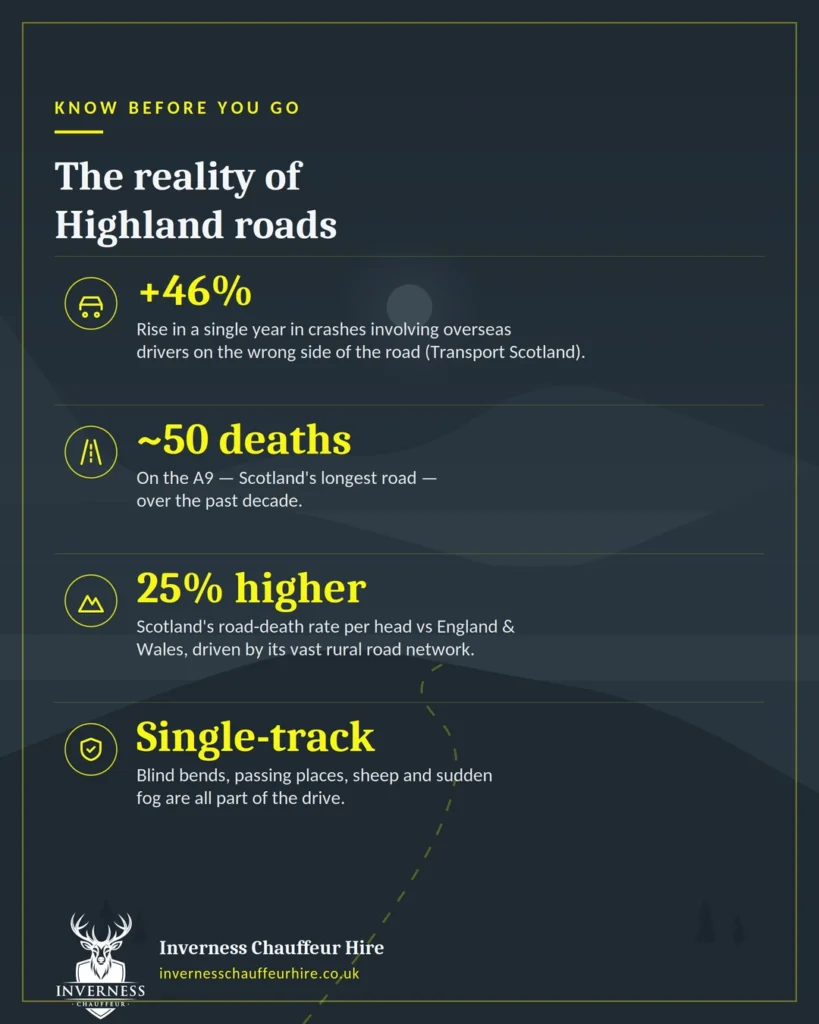
Feeling nervous about driving in Highlands is common, and it’s rational. These roads ask for confidence most visitors haven’t built yet. In May 2025 Transport Scotland reported that crashes involving overseas drivers on the wrong side of the road had jumped 46% in a single year (reported by CNN). That’s not a scare stat. It’s a signal that unfamiliar roads plus unfamiliar driving is a genuinely hard combination.
Hiring a chauffeur isn’t the indulgent option here. Quite often it’s the sensible one. Here’s the honest case for handing over the keys.
Jump to Section
Is driving in Highlands actually dangerous?
Not inherently but rural roads carry more risk than urban ones. Scotland’s road-death rate per head runs about 25% higher than England and Wales, and the A9 alone has seen close to 50 deaths in the past decade. Care matters more here.
Driven well, the Highlands are perfectly safe. The issue is that “well” asks more of you than a motorway does. Higher average speeds on open rural roads, narrow carriageways, no street lighting and wildlife crossings all stack the odds against a distracted or nervous driver.
The numbers back it up. Scotland’s fatality rate per head sits roughly a quarter above England and Wales, largely down to its huge rural road network (car.co.uk analysis of DfT data, 2026). The A9 between Inverness and Perth has a grim reputation for a reason.
A Highland hotelier was worried enough to start selling voluntary “T-plate” stickers in 2025, so other drivers know a tourist’s at the wheel. They’ve no official status in the Highway Code. But the fact they exist tells you how stressful visitors find these roads.
Why do so many visitors feel nervous and is that normal?
It’s completely normal. Driving on the left for the first time, on single-track roads with passing-place etiquette and mist that swallows the view, triggers real stress, even for confident drivers who handle motorways at home without a thought.
Driving anxiety usually comes from a stack of small unknowns rather than one big fear. Unfamiliar rules. Reduced visibility. The worry of holding up a local who clearly knows the road. Uncertainty about where the next passing place is.
Put them together on a misty climb near Glencoe, where visibility drops in minutes, and even seasoned drivers admit the Highlands demand full concentration. Which is the catch: total concentration on the road means you can’t absorb the scenery, and the scenery is why you came.
- Driving on the left, often for the first time
- Single-track roads and passing-place timing
- Fear of holding up faster local traffic
- Navigation nerves where the mobile signal drops out
- Sudden fog, rain and side-wind on high ground
What does a chauffeur actually take off your plate?
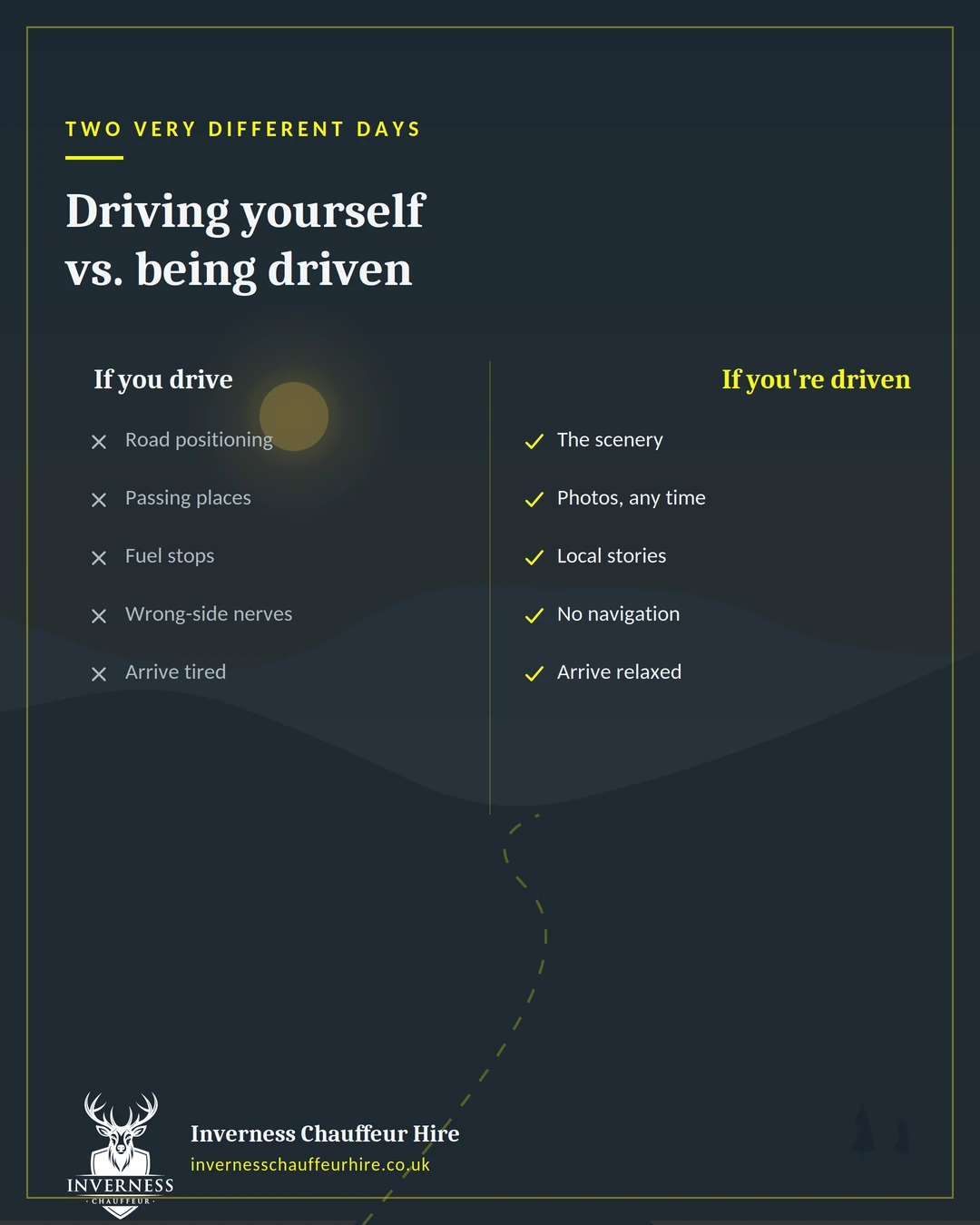
Everything that makes Highland driving stressful, road positioning, passing places, fuel stops, navigation and fatigue, shifts to the driver. You’re left with the parts you came for: the view, the photos, the conversation and arriving relaxed.
The swap is stark once you see it side by side. Drive yourself, and your attention goes to the mechanics. Get driven, and it goes to the experience.
| On the drive | If you’re driving | With a chauffeur |
| Your focus | Road, signs, passing places | The scenery and the stories |
| Photography | Snatched between corners | Any time, from a safe stop |
| Navigation | You, and a patchy signal | Handled, with local knowledge |
| Fatigue | Builds over long rural stretches | Not your problem |
| Arrival | Tense after a hard drive | Relaxed and ready |
If you’re weighing it against a hire car in general, we go deeper in our guide on chauffeur versus self-driving in Scotland.
What can a local driver read that a sat-nav can’t?
A Highland chauffeur reads conditions, not just directions: which roads flood after heavy rain, where sheep cross, when North Coast 500 traffic peaks, and how to handle a tight passing point smoothly. Judgement built from experience, not a map.
A sat-nav is confident and often wrong about the things that matter here. It doesn’t know the ford past the farm runs high after rain, or that a particular lay-by is safe while the next one isn’t.
Seasons change the rules, too. The Cairngorms in winter need a completely different approach to the coastal roads near Durness in a summer gale. That kind of reading only comes from driving these routes in every condition, year after year.
Does hiring a chauffeur really beat a hire car on cost?
Often, once you count the extras. Rental fees, insurance excess, fuel, parking and the risk of scraping a car on a narrow road add up and for groups or multi-day trips, a chauffeur can work out better value, before you even price in peace of mind.
The sticker price on a hire car looks lower until you add the rest. Insurance excess. Fuel across long distances. The very real chance of kerbing an alloy in a passing place. Split between three or four people, a chauffeur starts to look sensible rather than lavish.
We break down the real figures in our guide to chauffeur service costs in Scotland, so you can compare like for like rather than guess.
When is hiring a chauffeur clearly the right call?
Book a chauffeur when you feel anxious about rural driving, you’re new to driving on the left, you want to focus on photography, you’re travelling with family, or you simply value comfort and local insight over doing it all yourself.
- You feel anxious about narrow, rural roads
- You’ve never driven on the left before
- You want to shoot photos without the schedule fighting you
- You’re travelling with family and want everyone relaxed
- You’d rather hear the local stories than stare at a sat-nav
The Bealach na Bà or the shores of Loch Ness aren’t meant to be endured with white knuckles. If the driving is the part you’re dreading, that feeling is worth listening to. Hand it over and enjoy the rest.
Frequently asked questions
Are Highland roads safe to drive?
Yes, when driven with care. Rural roads statistically carry more risk than urban ones, so they reward confidence, patience and local knowledge, exactly what a chauffeur brings.
Is a chauffeur better than a guided bus tour?
If you value flexibility, privacy and stopping when you like, yes. A private driver bends the day around you instead of a fixed timetable and 40 other passengers.
Do I need to worry about driving on the left with a chauffeur?
Not at all, that’s the whole point. You never touch the wheel, so the side of the road, roundabouts and passing places stop being your problem.
What are the most nerve-racking roads for visitors?
The A9, the single-track sections of the NC500, Bealach na Bà and the misty climbs around Glencoe come up most often. A local driver handles all of them routinely.
Can I still stop for photos with a chauffeur?
More easily, in fact. The driver finds a safe place to pull in, so you can shoot without becoming a hazard on a single-track road. Ready to travel the Highlands the easy way? Book your chauffeur or get in touch

An experienced chauffeur who enjoys exploring the beautiful landscapes of Inverness and writing about her experiences. Passion for driving and storytelling, desire to excel in her career and personal interests.