
Handing your day to a Highland chauffeur only feels effortless because of everything that happened before you got in the car.
Understanding how chauffeurs are trained for Highland travel explains why they’re worth it. The roads here are genuinely demanding in May 2025 Transport Scotland reported a 46% rise in a single year in crashes involving overseas drivers on the wrong side of the road (reported by CNN). A professional chauffeur is trained specifically so those conditions never become your problem. Inverness, the gateway to the Highlands, is where most of that training gets put to work.
The skill set goes well beyond “can drive a nice car.” It’s advanced driving, weather craft, vehicle knowledge and service, layered on top of local experience. Here’s what that actually involves.
Jump to Section
Why do Highland roads demand special training?
Because the terrain is unforgiving. Narrow single-track roads, sharp bends near mountains like Glencoe, little street lighting, remote routes and fast-changing weather all combine, conditions a standard driving test never prepares anyone for.
The road network around Inverness and the wider Highlands is a different animal to a city: single-track lanes linking rural communities, blind bends near the mountains, barely any lighting once you leave town, and long remote stretches with no traffic management at all.
Add weather that turns in hours, fog off the lochs, heavy rain, winter ice, wind across open moor and remote destinations far from help, and you have a place that rewards training and punishes improvisation. It’s the same reason we always recommend a chauffeur over a hire car; our guide on chauffeur versus self-driving lays out why.
What driving qualifications does a chauffeur need?
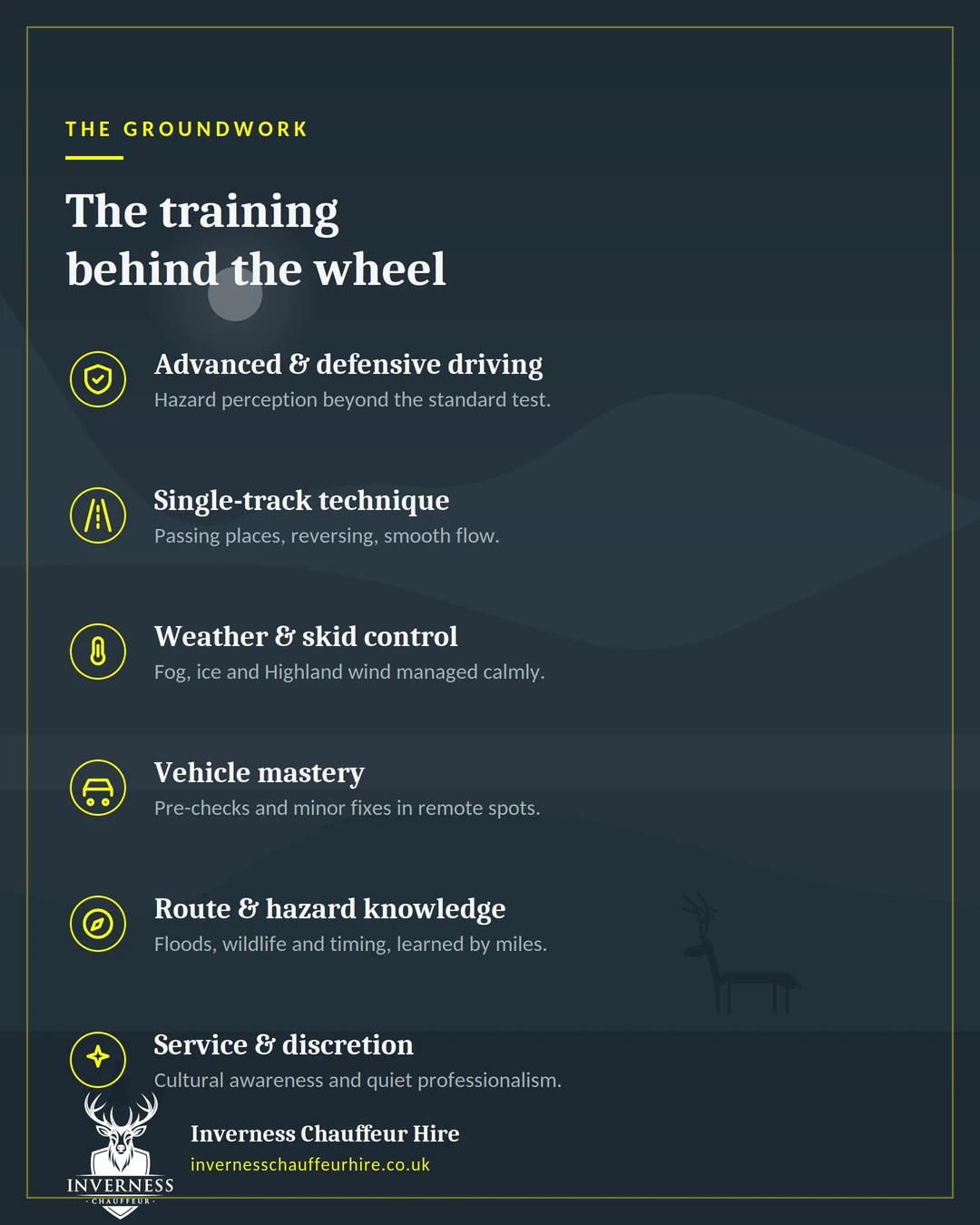
It starts with advanced driving certification well beyond the standard test, professional defensive driving focused on hazard perception, anticipating wildlife and obstacles, safe distances on narrow roads and smooth, controlled vehicle handling.
The foundation is advanced, defensive driving, the kind of training that treats hazard perception as a discipline. Reading the road far ahead, anticipating a deer or a farm vehicle, holding safe distances where the lane barely fits one car, and keeping everything smooth for the passenger.
On top of that sit formal programmes: advanced driving assessments, rural hazard-awareness modules and emergency manoeuvre training. Together they mean a chauffeur can handle the variety the Highlands throw at them without it showing in the back seat.
How are chauffeurs trained for single-track roads and bends?
With region-specific technique: using passing places correctly, communicating courteously with oncoming drivers, reversing safely when needed, and controlling braking and gears through the sharp, steep bends that define Scotland Highland roads, all while keeping passengers comfortable.
Single-track roads have their own etiquette, and getting it wrong causes the stand-offs visitors dread. Chauffeurs train to read passing places early, wave others through with good grace, reverse smoothly when it’s their turn, and keep the traffic flowing.
The bends get their own work too, controlled braking before the corner, the right gear for a steep up or downhill, and a line that keeps passengers comfortable rather than queasy on a winding road.
How do they train for Highland weather?
Through weather-specific drills. Chauffeurs train to use fog lights correctly and hold safe speeds in low visibility, and to manage winter conditions with skid control, gentle braking on ice and the right tyres so a sudden change never turns dangerous.
Fog is a Scottish Highland regular, especially around the lochs, so chauffeurs drill low-visibility driving, fog lights, safe speeds, staying inside the lane when you can barely see it.
Winter raises the stakes with ice and snow, which means skid control, careful braking and proper winter tyres. It’s exactly this training that lets us keep running winter chauffeur tours when a nervous self-driver would, sensibly, stay put.
What about the vehicle and remote breakdowns?
Chauffeurs are trained in vehicle mastery: thorough pre-departure checks of tyres, brakes, fluids and fuel, an understanding of how the car behaves on steep or uneven terrain, and the ability to handle minor issues and coordinate help safely in remote areas.
Out in the remote Highlands you can’t assume a garage is round the corner, so self-sufficiency is part of the training. Every trip starts with checks, tyres and pressures, brakes, fluids, and enough fuel for a long run with margin.
Chauffeurs also learn how a vehicle responds to steep gradients and uneven ground, how to manage a minor mechanical issue calmly, and how to keep passengers safe and comfortable while help is arranged. It’s the unglamorous backbone of a reliable private chauffeur service.
Is it just driving, or service too?
Both. Alongside the driving, chauffeurs train in service excellence, polite, discreet communication, confidentiality, cultural awareness for international guests, and tailoring the journey with scenic routes and well-chosen stops. The driving keeps you safe; the service makes it memorable.
A Highland chauffeur is also, quietly, a guide. Training covers respectful communication, discretion and confidentiality, and cultural awareness for guests arriving from all over the world.
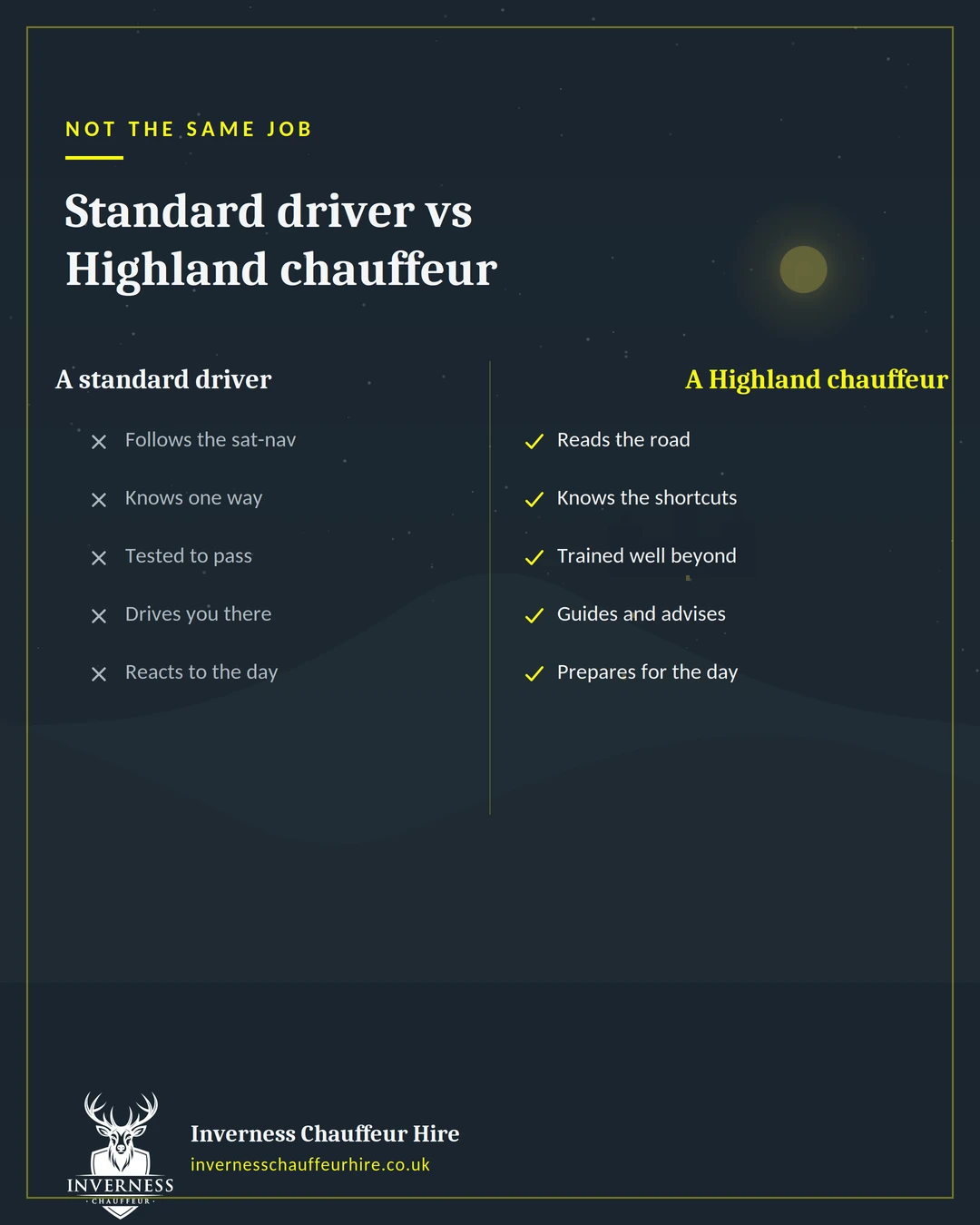
Here’s the gap in practice and it’s the whole case for hiring a trained chauffeur in the Highlands:
| Skill area | Standard driver | Highland-trained chauffeur |
| Roads | Follows the sat-nav | Reads conditions and shortcuts |
| Single-track | Learns on the day | Trained technique and etiquette |
| Weather | Hopes for the best | Fog, ice and wind drilled in advance |
| Breakdowns | Calls for help | Checks, prevents and manages calmly |
| Service | Gets you there | Guides, tailors and reassures |
Frequently asked questions
Is it safer to hire a chauffeur in the Scottish Highlands?
Generally, yes. Professional chauffeurs are trained for the region’s single-track roads, weather and remoteness, which makes travel considerably less stressful and safer for visitors.
Do Inverness chauffeurs train differently to city drivers?
Yes, they add rural driving technique, weather adaptation and Highland navigation on top of standard professional training.
What driving qualifications do chauffeurs hold?
Typically advanced and defensive driving certifications, plus rural hazard-awareness and emergency-manoeuvre training beyond the standard licence.
How do chauffeurs handle long, remote Highland journeys?
Through careful planning, thorough vehicle checks and advanced technique with the self-sufficiency to manage minor issues far from a garage.
Do chauffeurs train for winter driving?
Yes. Skid control, safe braking on ice and correct winter tyres are all part of preparing for Highland winters. Ready to travel the Highlands the easy way? Book your chauffeur or get in touch

An experienced chauffeur who enjoys exploring the beautiful landscapes of Inverness and writing about her experiences. Passion for driving and storytelling, desire to excel in her career and personal interests.